

Last updated on 19 February 2026 by Brisbane Livewell Clinic Editorial Team
Understanding Paediatric Nutrition and Faltering Growth (Failure to Thrive) is important to all new parents. Ensuring their child receives adequate nutrition is on the top of the priority list for parents and carers, as it directly affects their growth and helps them reach developmental milestones.
Breastfeeding is recommended
The Australian Government (1) recommends breastfeeding where possible, as it offers protection against infection, and lowers the risk of developing some chronic diseases including Type 1 and 2 Diabetes, coeliac disease and cardiovascular diseases. In Australia, it is recommended that infants be exclusively breastfed until 6 months of age when solids are introduced. Breastfeeding is recommended to continue until at least 12 months of age and beyond, so long as both mother and infant desire.

However, some mothers have trouble breastfeeding fully or partially
However, some mothers may have difficulties with breastfeeding and should seek help from health professionals, family and community organisations where possible.
Although exclusive breastfeeding is ideal, any amount of breastmilk is most beneficial.
Where breastfeeding is unable to be offered, commercial infant formulas should be used as an alternative until at least 12 months of age.
Cow’s milk-based formulas are the preferred option, however, specialty-based formulas are also available for those with cow’s milk allergies or other allergies and should be used under the guidance of a healthcare professional.
It is important that parents seek assistance from qualified professionals such as Dieticians to ensure their baby is receiving the right nutrients.
Introduction of foods from 6 months of age
At 6 months of age, infants are developmentally and physiologically ready for new foods, textures and modes of feeding, and need more nutrients than breastmilk and/or milk formula cannot provide alone.
The texture of foods introduced should be suited to the infant’s development stage, moving from smooth pureed to lumpy to normal textures during the 6-12 month period.
Foods can be introduced in any order, with iron-rich foods among the first foods to be provided.

At 6 months of age, iron stores from birth are exhausted, and breastmilk and milk formulas lack iron and therefore need to be provided from food. Suitable iron-rich foods to provide to infants include iron-rich baby cereal, beef, pork, chicken, tofu, beans and legumes, and eggs.
By 12 months of age, infants should be eating the same foods and textures as the rest of the family.
Your Dietician can advise you during this transition from breastmilk or formula through to eating solid foods.
Read about Food for Health: Nourishing your Body to Improve your Well-Being.
Importance of seeking advice over concerns about baby’s growth
Parents and carers often seek advice from healthcare professionals about concerns with growth. Weight is routinely measured as surveillance in young children, which alerts to potential growth concerns (2). Your GP, Paediatrician and Dietician may all be involved in your baby’s care.
The term ”faltering growth” (previously known as “failure to thrive”) is widely used to refer to a slower rate of weight gain in childhood than expected for age and sex at birth (2).
In the early days of life, some weight loss is to be expected, and is related to loss of bodily fluids, with most infants returning to birth weight by 3 weeks of age (2).
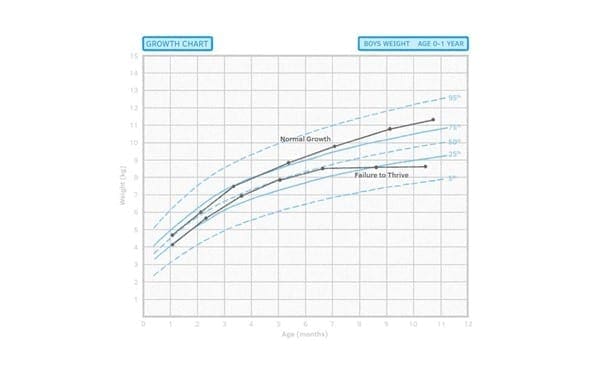
This is an example of a growth chart, displaying normal growth and faltering growth.
What is Faltering Growth?
Faltering growth can be seen on the bottom line where growth does not follow the same percentile and begins to drop off and cross percentiles. This can be due to a variety of factors, mainly inadequate nutrition, however, can also be due to late introduction to solid foods, and different disease states such as coeliac disease and allergies that affect the absorption of food.
It is important that if there are any concerns with feeding to seek help from a healthcare professional, such as an Accredited Practicing Dietitian (APD) to perform a clinical assessment, and whether further support from other healthcare professionals need to be provided or health investigations need to be carried out.